
What a New Independent Comparison Tells Us About EV Isolation Methods
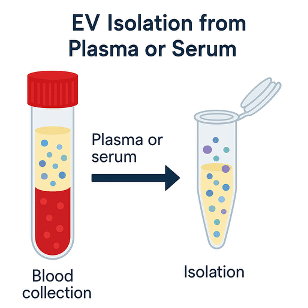
If you've ever stood in front of a freezer of biobanked plasma wondering which isolation method will actually give you usable EVs, you're not alone. The choice has real consequences — for yield, for purity, for whether your downstream assay works at all — and until recently, most published comparisons covered two or three methods at a time.
A new study from Figueroa-Hall and colleagues, published in Journal of Extracellular Biology (2025), goes further. The team compared five EV isolation approaches across seven commercial and standard methods using small volumes of human plasma and serum, with a focus on isolating both total EVs (TEVs) and astrocyte-enriched EVs (AEEVs) for neuroscience biomarker work.
Here's what stood out.
The yield-versus-purity tradeoff is real — and quantifiable
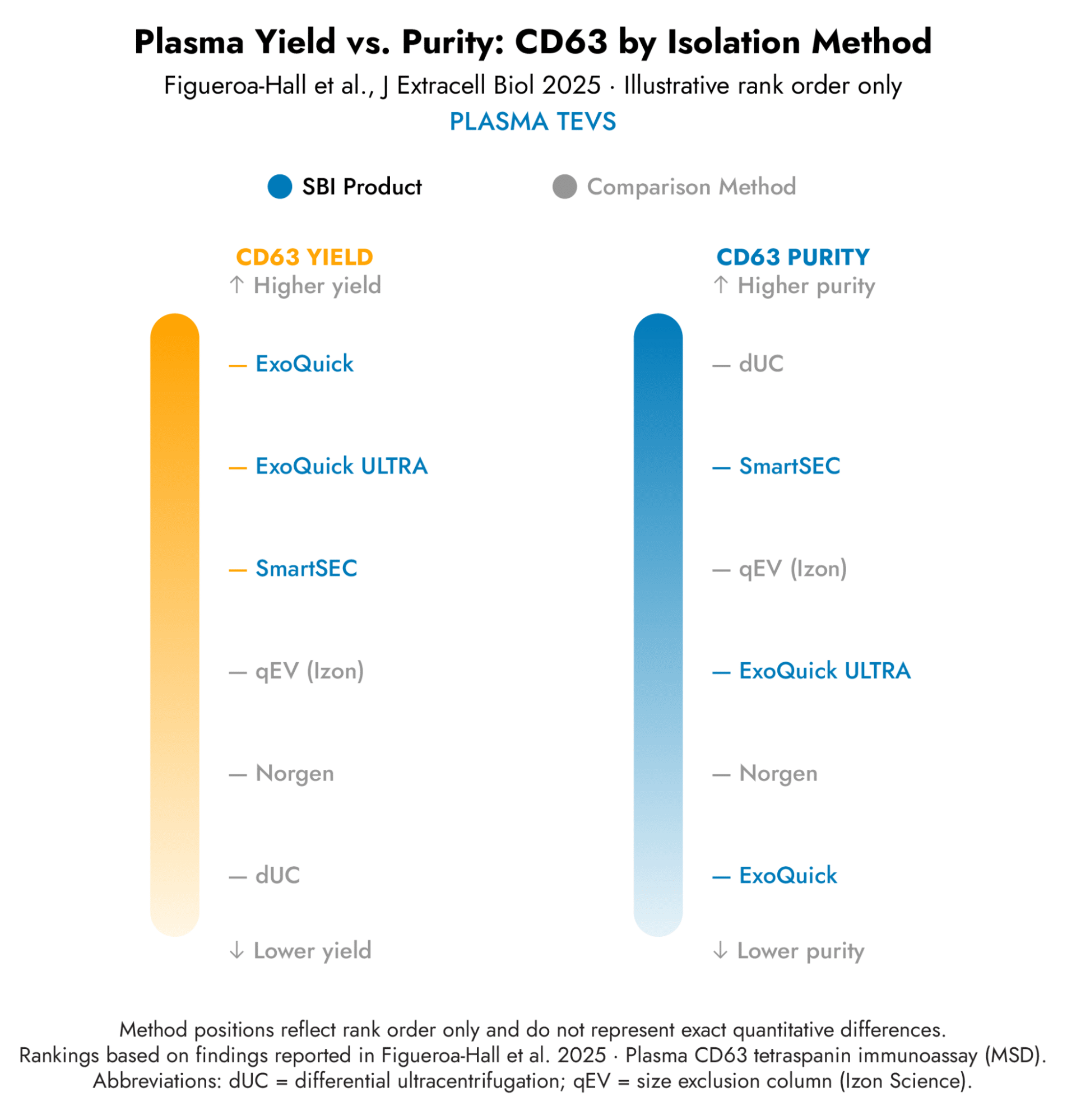
The headline finding won't surprise anyone who's been in the field: precipitation methods produce higher EV concentrations, while size-exclusion chromatography (SEC) produces higher purity. What's useful is how much difference each method made.
In plasma TEVs measured by CD63:
- ExoQuick (precipitation) delivered the highest yield
- SmartSEC (SEC) was 8.7-fold purer than ExoQuick
In serum TEVs:
- SmartSEC had the highest yield
- Differential ultracentrifugation produced the purest sample — but yielded 91-fold less CD63 than SmartSEC
The takeaway isn't that one method "wins." It's that the right choice depends entirely on what your downstream assay needs. Western blot for low-abundance proteins? You'll want yield. Mass spec or proteomics where contaminating lipoproteins ruin the run? You'll want purity.
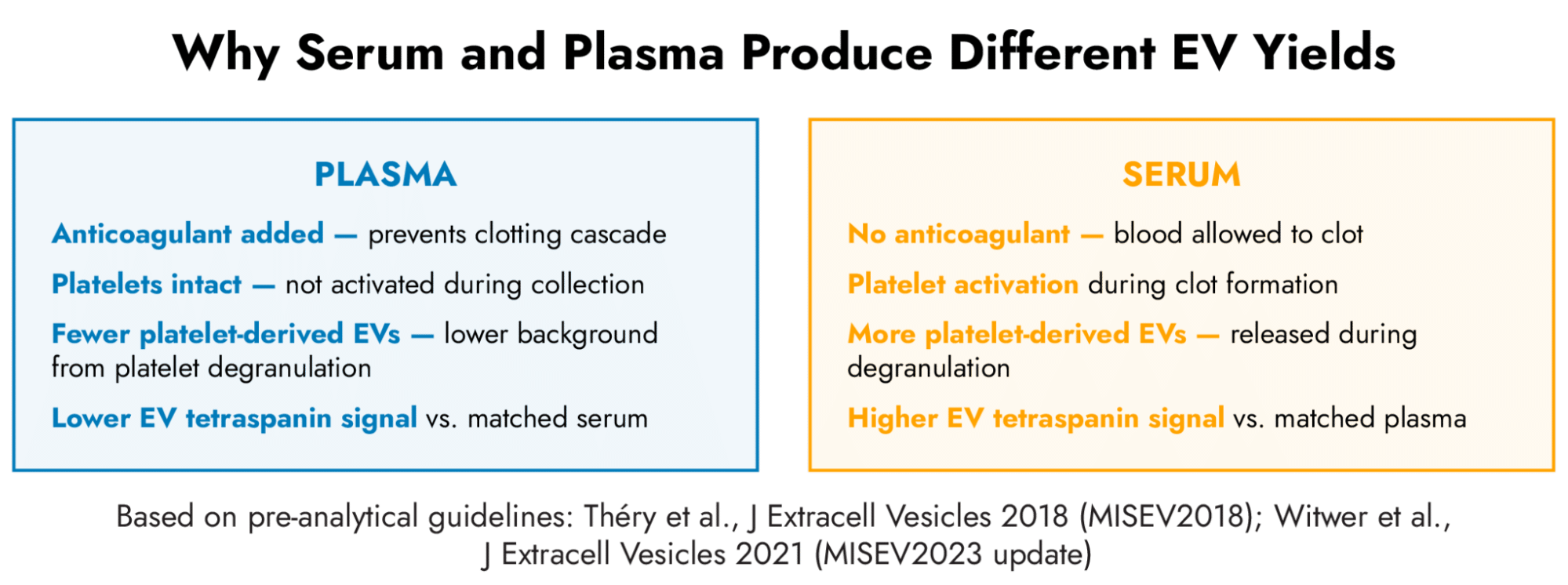
Serum and plasma aren't interchangeable
Across nearly every method, serum TEVs showed higher tetraspanin concentrations than plasma TEVs — sometimes by 5- to 22-fold. If you've been treating these two matrices as equivalent, this paper is a useful reminder that the choice of biofluid changes what you're measuring.
The exceptions were Norgen and ultracentrifugation, both of which produced low EV counts regardless of starting material.
Proteinase K treatment isn't free
PK is often used to clean up co-isolated proteins, but the study showed it eliminated 98–100% of CD81 and CD9 signal across all methods, while CD63 was largely preserved. If your work depends on CD81 or CD9 surface markers, PK after isolation may quietly be costing you the signal you're trying to measure.
Astrocyte-enriched EVs followed the same pattern
When the authors immunocaptured GLAST-positive AEEVs from total EVs, the yield-versus-purity relationship held. ExoQuick-derived AEEVs had the highest particle concentrations and strongest flow cytometry signal for CD81 and GLAST. SmartSEC- and qEV-derived AEEVs were less concentrated but cleaner.
For researchers doing brain-derived EV biomarker work from peripheral biofluids — an area moving quickly in Alzheimer's, Parkinson's, and major depressive disorder research — this is the first head-to-head comparison of its kind.
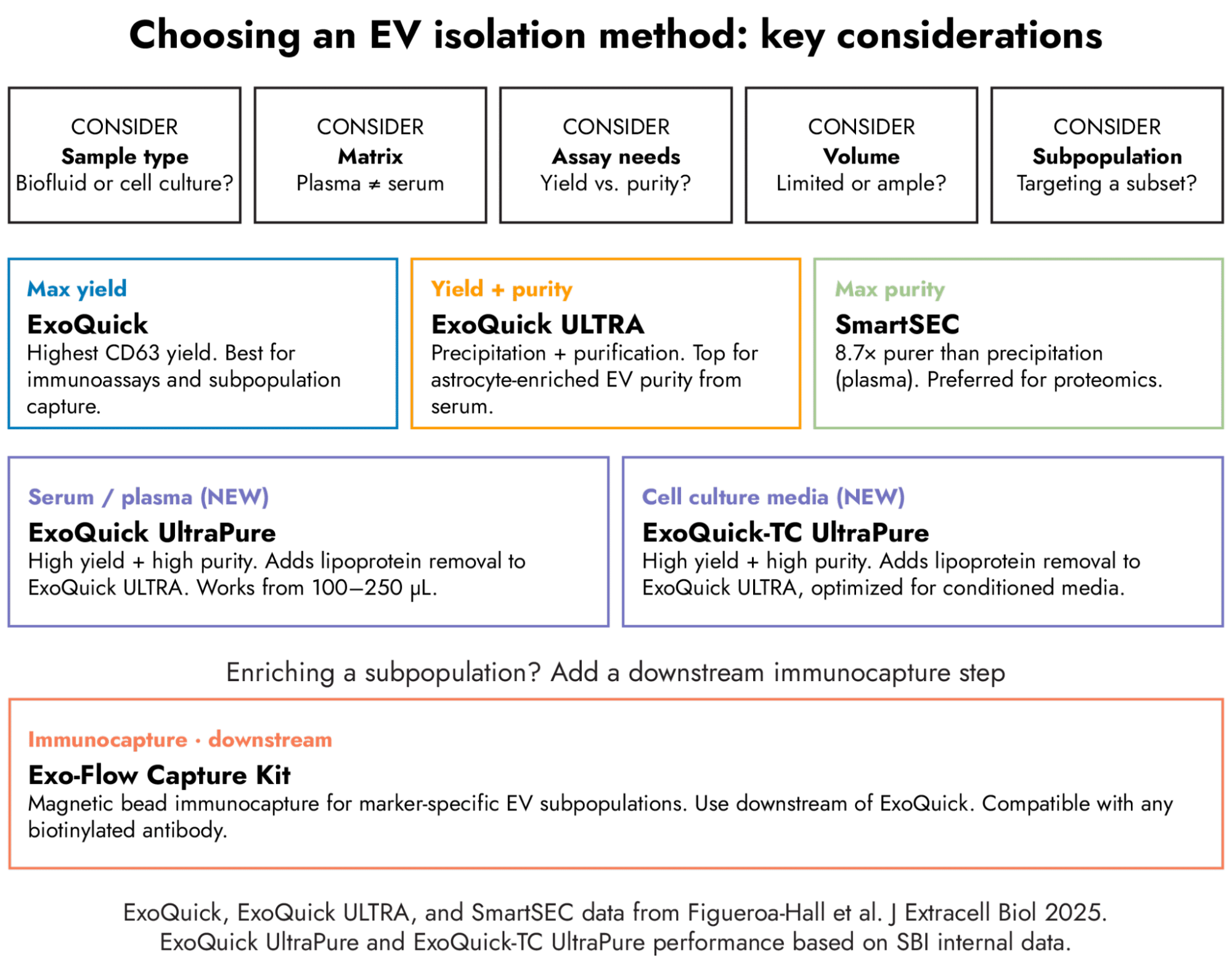
What this means for method selection
The paper's most useful contribution isn't a verdict — it's a framework. Before choosing an isolation method, ask:
- What's the downstream assay? Tetraspanin immunoassay tolerates more co-isolated protein than mass spectrometry.
- Plasma or serum? They are not equivalent matrices.
- What sample volume do you have? Biobanked clinical samples often force the choice toward methods that work with 200–500 µL.
- Are you enriching subpopulations? Immunocapture downstream of isolation can rescue purity, but starting yield still matters.
For groups working through these tradeoffs, our team supports the EV community with isolation tools across the spectrum — ExoQuick for high-yield precipitation, SmartSEC for high-purity SEC (available in Single, Mini for small volumes, and HT for high-throughput formats; SmartSEC-DeLipo adds lipoprotein removal for proteomics-grade purity), ExoQuick ULTRA for precipitation-plus-purification, and our newest launch, ExoQuick-TC UltraPure and ExoQuick UltraPure, build on ExoQuick ULTRA by incorporating additional chemistry to remove lipoproteins, enabling improved performance for cell culture media and serum/plasma workflows, respectively, when both high yield and high purity are required.
The full paper is open access and worth reading in detail: Figueroa-Hall et al., J Extracell Biol 2025.
Have questions about matching an isolation method to your sample type or downstream application? Talk to one of our EV specialists.
You might also be interested in:
- SmartSEC-DeLipo™ — SEC + lipoprotein depletion for proteomics-grade purity
- SmartSEC Mini — optimized for small volumes (10–100 µL)
- SmartSEC HT — 96-well format for high-throughput workflows
- SmartSEC-TC — optimized for cell culture media
- Exo-Flow Capture Kit — magnetic bead immunocapture for EV subpopulation enrichment
For Research Use Only.
